A year and a half has passed, and only 20% has been utilized. RES subsidies for low-income households are flowing slowly.
The state is attempting to support low-income households with 90% subsidies for photovoltaics, solar collectors, and boilers. 'We expected a slower uptake,' the government agency responds.
While the "Green for Households" (Zelená domácnostiam) project, which has been operating for over a decade, is currently at a standstill due to exhausted EU fund allocations—and a similar subsidy program for companies, "Green for Enterprises," is also waiting to restart—the situation is entirely different for the new "sub-program" targeting low-income households. Eighteen months after its launch, less than 20% of the financial allocation has been spent.
The Ministry of Economy and its subordinate, the Slovak Innovation and Energy Agency (SIEA), which also administers the "standard" Green for Households program, launched this special project for low-income earners in October 2024. Since then, "Green Solidarity" (Zelená solidarita) has supported approximately 1,100 installations, with €22.8 million still available from the total €28.4 million budget.
Less than two years ago, the Ministry of Economy announced changes, claiming the "Green for Households project will be fairer" and that Green Solidarity would support low-income households with grants covering up to 90% of eligible costs. These special subsidies can be used for photovoltaic panels, solar collectors, and biomass boilers (wood, pellets, and briquettes).
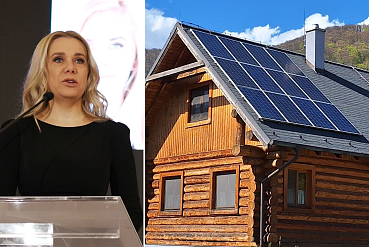
"We are introducing the Green Solidarity project to help low-income households most at risk of energy poverty. We know that renewable energy devices, which help lower energy bills, are very expensive for them and they could not afford them until now. We are bringing them this opportunity and believe they will take advantage of it," stated Minister of Economy Denisa Saková at the project's launch.
"We have set the conditions so that while regular households can receive a grant covering a maximum of 50% of the purchase and installation costs from the Green for Households project, low-income households will receive a grant from Green Solidarity covering up to 90%. The state will thus contribute more," emphasized the head of the Ministry.
Since then, Green Solidarity has been one of two options for low-income households to access enhanced energy assistance. The second option is the "Renew House Mini" (Obnov dom mini) calls under the Ministry of Environment, though those rules are structured differently.
SIEA: We Will Analyze the Situation
According to SIEA, the fact that Green Solidarity has distributed only a fraction of its allocation since Autumn 2024, while the "classic" program repeatedly runs dry, is no surprise. We asked what is behind this and whether planned changes to Green for Households will also affect Green Solidarity.
"A different pace of utilization was expected," responded agency spokesperson Zuzana Valentová for Energie-portal.sk. "Compared to the Green for Households project, Green Solidarity has two fundamental differences that affect interest in the subsidies."
The first difference is the narrower circle of eligible applicants. "Support up to 90% of eligible costs is intended only for low-income households and households with a person with a severe disability," explained Valentová.
The second significant difference is the mandatory verification of eligibility before a voucher is issued. While in the Green for Households project, vouchers are issued automatically upon activation by the contractor, in Green Solidarity, the household must first grant consent for the disclosure of tax secrets and personal data.
"Subsequently, in cooperation with public institutions, we verify whether they meet the conditions for increased support. This process takes some time, and approximately 25% of applicants ultimately do not meet the income criteria," Valentová continued.
According to current SIEA data, households have utilized €5.6 million in subsidies for over 1,100 installations within the Green Solidarity project. Thus, roughly 80% of the allocation remains unspent.
In the case of Green for Households, the agency plans to restart subsidies thanks to the transfer of over €20 million from other areas within the "Slovakia Program." However, current EU fund transfers will not affect Green Solidarity, and SIEA has not mentioned any funding cuts for low-income households for now.
"The announced increase in allocation for the Green for Households project, based on the findings of the Slovakia Program review, has no impact on the Green Solidarity allocation. Currently, over €20 million is available in this program. We will analyze the options for utilizing these funds in the coming months," added Valentová.
What exactly the SIEA analysis will bring remains to be seen. However, the amount of funds utilized from Green Solidarity should gradually grow.
"New applications continue to come in, and interest is growing. We record approximately 300-350 new applications monthly where consent for income verification has been delivered. We process submitted reimbursement requests continuously," the SIEA spokesperson concluded.
How the Conditions are Structured
The objects of support in Green Solidarity are photovoltaic panels, solar collectors, and boilers for wood pellets, wood gasification, and briquettes.
A "small installation" in family houses is defined as a device for electricity production with a capacity of up to 10.8 kW or for heat production covering the energy needs of a building used by individuals for housing, up to a maximum capacity of 1 MW.
"The 90% benefit from the Green Solidarity project is intended for low-income households at risk of energy poverty," SIEA explains on the project website.
The support distinguishes between two categories of low-income households at risk of energy poverty based on income thresholds. A household is eligible if:
-
It is at risk of income poverty (i.e., its disposable income is less than or equal to the set limit).
-
It is at risk of income poverty and includes a person with a registered residence who has a severe disability, while the household's disposable income is less than or equal to the set limit.
Source: https://www.energie-portal.sk/