
Balcony photovoltaics can save households up to 25% of their consumption
Legislation turns solar kits into common household appliances. A standard 800 W balcony set can cover 25% of an apartment's consumption. The return on investment in a city solar solution has dropped to 3 years.
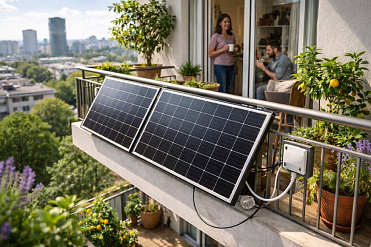
Photovoltaics will definitely leave the roofs of industrial buildings and move to the balconies of city apartments in 2026. New legislation in many countries has reclassified small solar systems with an output of up to 1.2 kW as ordinary household appliances. This revolutionary step means that the user does not need complex permits from distribution companies and the panel can simply be plugged into a regular wall socket.
A typical balcony kit in 2026 consists of one or two panels with a total output of 800 W, which will generate up to 1,400 kWh of electricity per year. For the average household in an apartment, this means a saving of 15% to 25% on monthly energy costs, which is a significant impact on the family budget. These systems are designed to be portable, so tenants can take them with them if they move without the need for structural modifications.
Technological progress has brought panels with an efficiency exceeding 21%, which also work better in low light. The new TOPCon cells allow for more power to be produced on the same surface area, which is crucial for limited balcony space. Modern kits are sold in the price range of $600 to $1,500 and are guaranteed to last for 25 years with minimal performance degradation.
By 2026, solar energy is set to become the world’s cheapest source of electricity, and balcony systems are the answer to rising bills. In California, average electricity rates are as low as $0.33 per kWh, which would allow for a payback period of just 4.3 years if installed before the end of 2025. Even without federal tax breaks in 2026, solar energy remains a sensible investment that serves as a hedge against energy price inflation.
In addition to the financial benefits, balcony photovoltaics play an important psychological role in engaging the public in the energy transition. Users who directly see energy production on their balcony tend to manage their consumption more efficiently and take an interest in sustainable technologies. Although individual systems are small, their cumulative contribution to decentralized energy production in cities becomes a measurable factor in stabilizing the grid.
Investing in a solar solution is therefore no longer seen as an environmental luxury in 2026, but as a rational economic decision. The higher efficiency of the panels means that even a small, south-facing space can generate enough electricity to run a refrigerator, for example. Solar energy is thus becoming democratized and no longer dependent on land ownership or a large roof of a family home.
WHY IT'S IMPORTANT: The expansion of balcony photovoltaics allows city dwellers to reduce their energy dependence without expensive and complex installations.