
Japanese Scientists Shatter Physics
Unveil Flexible Solar Panel with Incredible Efficiency
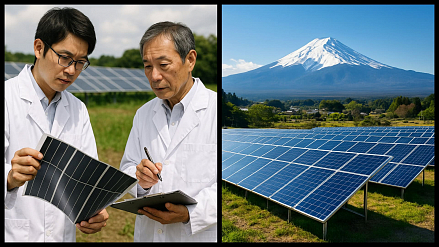
Researchers at Tokyo City University have achieved a technological breakthrough that will fundamentally change the use of solar energy. They have developed a new type of flexible tandem solar cell that has achieved a record-breaking efficiency of 26.5 percent. Tandem solar cells combine two different technologies in one structure, allowing them to capture more sunlight and convert it into electricity more efficiently than conventional panels.
In this instance, the scientists combined two layers – a semi-transparent upper perovskite cell and a lower thin-film silicon HJT (heterojunction) cell. This combination has overcome previous limits of flexibility and performance, representing a huge step forward, especially for areas where lightweight and flexible solar technology is needed, such as building rooftops or vehicles. The InterestingEngineering portal highlighted this development.
How the New Solar Cell Works and What Makes it Different
Perovskites are materials that have revolutionized solar cell research in recent years, enabling high efficiency at a low cost. However, their weakness has been fragility and low flexibility. In contrast, silicon cells are traditionally rigid and durable but heavy and less adaptable. In this case, however, the scientists managed to leverage the advantages of both technologies.
The lower silicon layer was modified using a special chemical process involving potassium hydroxide etching, which significantly thinned it without losing its ability to generate electricity. This process also improved its surface properties to better accept the upper perovskite layer. The upper layer was designed using advanced materials such as MeO-2PACz, C60, or SnO₂, which increase the efficiency of light-to-electricity conversion. Together, these innovations created a cell that not only achieves very high efficiency but is also flexible, allowing it to be bent and adapted to various surfaces.
The Future of Flexible Solar Energy
The researchers at Tokyo City University are not stopping at this record. Their goal is to further increase the performance of these tandem cells by better aligning the electrical currents between the upper and lower cells, which is key to maximizing solar energy utilization. They also plan to apply bifacial technology, which will allow the lower cell to receive light from the rear side, further increasing energy production.
Additionally, they plan to test the long-term mechanical durability and flexibility of the cells to ensure they are suitable not only for buildings but also for mobile devices, vehicles, or wearable electronics. If this research proves successful, we can expect a massive expansion of lightweight and high-performance solar technologies, which could significantly contribute to the global transition to renewable energy sources.