
LONGi has a record photovoltaic cell! What does 35.5% mean in practice?
The Chinese company LONGi has pushed the efficiency of a perovskite-silicon tandem cell to 35.5%.
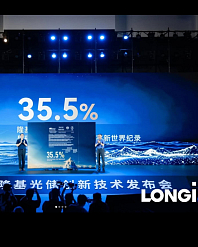
It can produce significantly more electricity from the same area than today's commercial photovoltaic panels.
The new perovskite-silicon tandem photovoltaic cell from LONGi has achieved an efficiency of 35.5%, which was confirmed by the European Solar Test Installation, or ESTI. This workplace belongs to the Joint Research Center of the European Commission and is dedicated to precise measurement and calibration of photovoltaic devices.
However, in the official announcement from LONGi, you will not find the product designation, dimensions of the finished panel, nominal power, voltage, current, weight, temperature coefficient, warranty or date of start of sales. The manufacturer introduced the photovoltaic cell, i.e. the basic electrically active component of which the panels are composed.
LONGi has thus so far set a world record in the category of crystalline silicon-perovskite tandem cells. The absolute most efficient solar cells use more expensive multilayer semiconductors from the III-V group. For example, in 2022, the American laboratory NREL achieved an efficiency of 39.5% in a three-junction cell under standard sunlight. However, such cells cost many times more and are mainly used in space or special applications.
LONGi's result is more important for conventional photovoltaics because it combines a perovskite layer with silicon, which is the basis of almost the entire current market. In the future, manufacturers could use existing silicon cells, production lines and supply chains and add a very thin perovskite layer to them. The word "could" is doing quite a bit of work here so far.
Two layers will use sunlight better than one
A conventional silicon cell contains one active semiconductor junction. Silicon processes some of the visible and infrared light well, but converts some of the energy into heat for photons with higher energy. At the same time, it cannot use photons with too low energy at all.
The tandem cell divides the work between two layers with different energy gaps. The upper perovskite layer mainly captures the more energy-rich part of the spectrum. Light with lower energy passes to the lower silicon cell, which converts it into electricity. Each layer thus works with the part of the spectrum for which it is better suited.
The manufacturer achieved an efficiency of 33.9% in November 2023 and 34.6% in June 2024 with the same tandem technology. Later, values of 34.85 and 35.2% followed, until the development reached the current 35.5%.
More important than the record on a small cell itself are the results on larger areas. LONGi achieved an efficiency of 34.3% with a cell with an area of 261 cm2 and 32.2% with an area of 274 cm2. This roughly corresponds to the dimensions of cells that are approaching industrial production.
What does 35.5% efficiency mean in real terms?
Manufacturers measure the performance of photovoltaic devices under standard test conditions. One square meter receives 1,000 W of radiation, the cell is at 25°C, and the laboratory uses the standardized AM1.5 solar spectrum.
An efficiency of 35.5% therefore means that one square meter of active cell area can provide approximately 355 W of electrical power under these conditions. For a panel with an area of 2.25 m2, we are talking about an output of almost 800 W!
The remaining energy is reflected, transmitted, or converted into heat by the cell. This does not mean that the cell converts exactly 35.5% of all the light falling on the roof every day. In practice, it operates at varying radiation intensity and usually at a temperature significantly higher than 25°C.
For comparison, we can use the commercially available LONGi Hi-MO X10, whose mass-produced versions achieve a maximum efficiency of 24.8%. One square meter thus represents approximately 248 W of power in standard measurements, or 550 W from a conventional 2.25 m2 panel. The record-breaking cell itself with an efficiency of 35.5% would provide up to 43% more power on the same active area.
However, this comparison pits a cell against a complete panel. The panel loses part of its active area through gaps between the cells, frame, wires, wiring and overlay. Therefore, it seems fairer to compare a commercial panel with an efficiency of 24.8% and a research tandem LONGi module with an efficiency of 31.4%. The tandem module would provide 314 W per square meter, or approximately 26.6% more.
A 10 kWp power plant would take up significantly less
With panels with an efficiency of 24.8%, you need approximately 40.3 m2 of net panel area for a nominal output of 10 kWp. With a tandem module with an efficiency of 31.4%, the same output would take up approximately 31.8 m2. The difference is 8.5 m2, i.e. an area saving of around 21%. In other words, a 10 kWp power plant would need approximately 4 fewer panels.
If the manufacturer were to once manage to transfer the entire 35.5% of the cell to a large panel without additional losses, 10 kWp would theoretically only need 28.2 m2, i.e. another almost 2 fewer panels. Compared to an efficiency of 24.8%, the area would decrease by approximately 30%. However, LONGi does not yet have such a panel, so this is only a physical calculation, not a product parameter.
We can also look at it the other way around. On a roof with a usable area of 40 m2, you can place approximately 9.92 kWp at an efficiency of 24.8%. A module with an efficiency of 31.4% would achieve 12.