
No more city heat
Solar panels on facades are the key to fighting rising temperatures
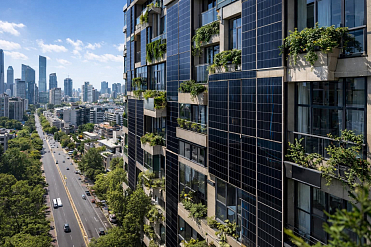
Solar Panels are No Longer Just for Roofs: The Secret Potential of Building Walls
Solar panels have long moved beyond being just a rooftop fixture. Scientists are now revealing that a massive, untapped potential is hidden right on the walls of our buildings. A new study published in the journal Nature Climate Change suggests that facade-mounted solar panels can significantly reduce energy consumption while helping cities better manage the impacts of climate change.
Building Walls as the New Power Plants
Research from the Chinese Academy of Sciences offers a fresh perspective on urban solar energy. While attention has historically focused on rooftops, the vertical surfaces of buildings have remained largely underutilized.
These surfaces, however, represent enormous potential. Facade Integrated Photovoltaic systems, known as FIPV, can convert sunlight into electricity without requiring additional space. At the same time, they act as a protective layer that prevents buildings from overheating.
One of the greatest benefits of facade solar panels is the reduced need for air conditioning. The panels shade the building from direct sunlight, helping to maintain lower indoor temperatures. According to researchers' calculations, building energy consumption could decrease by an average of more than 8%. In cities where air conditioning accounts for a significant portion of electricity use, this represents a major breakthrough.
Massive Global Potential
Modeling shows that if facade solar panels were implemented on a large scale, they could generate up to 732.5 terawatt-hours of electricity annually. This would constitute a significant share of global renewable energy production.
Even more critical is their environmental impact. Scientists estimate that by mid-century, carbon dioxide emissions could be reduced by as much as 37.7 billion tons.
The advantages, however, are not just ecological. According to the study, more than 80% of the urban areas analyzed would see lower electricity costs over the lifespan of the buildings. This means the investment would pay off not only for the environment but also economically. Facade solar panels represent a solution that merges cost savings with sustainable urban development.
Despite this vast potential, the adoption of this technology won't be automatic. Researchers warn that success will depend on several factors, including urban architecture, climatic conditions, and local regulations. Government policies and support from local municipalities will also play a vital role. Every city has different conditions, and solutions will need to be tailored to specific environments.
One thing is certain: with rising temperatures and increasing energy demands, cities will be forced to seek new solutions. Facade-mounted solar panels may be one of the most important steps toward making modern cities more energy-efficient and resilient to climate change.
Source: https://fontech.startitup.sk/