SAPI came up with the concept of a community resource, it can start electricity sharing
Electricity sharing is gaining importance in Slovakia, but the practice still encounters limits that hinder larger and more meaningful projects. The Slovak Association for Sustainable Energy (SAPI) has therefore proposed introducing the concept of a community source into legislation - a new concept that could open the door to more efficient functioning of energy communities.
Community source proposal
According to SAPI, the current local source institute is bound by relatively strict rules. By law, it is tied to a single point of consumption and its output cannot exceed the maximum reserved capacity (MRK). In practice, this means that larger joint solutions (shared sources with higher output), for example for apartment buildings, municipalities or wider groups of consumers, are very difficult to get off the ground.
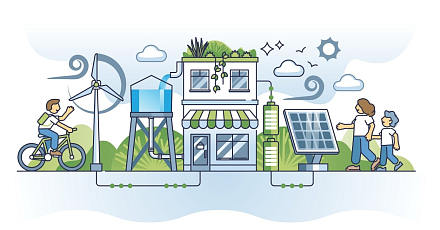
SAPI is responding to this problem by proposing the concept of a community source. This would allow for the construction of larger photovoltaic, wind or other devices based on renewable energy sources and the generated electricity to be subsequently distributed among several members of the energy community.
The MRK would not be assessed only for one point of consumption (as is the case with a local source), but as the sum of the capacities of all connected consumers. Such a setting would allow for significantly better use of suitable locations and investments in electricity production. Shared battery storage could also be part of the solution.
Although Slovak legislation already recognizes concepts such as energy community or community producing energy from renewable sources, in practice there is still a lack of functional mechanisms that would allow electricity to be shared simply and effectively. The proposal for a community source has the ambition to fill this gap.
Distribution companies willing to discuss the proposal further
The positive news is that the discussion is not just on paper. According to Libor Láznička, a member of the SAPI executive committee, representatives of companies with ownership ties to Západoslovenská distribučná and Východoslovenská distribučná declared their willingness to discuss this proposal further in a professional manner at a recent meeting.
"It is important for us that the debate has been opened in a substantive and constructive manner. It may not look exactly as we are proposing today, but what is important is that we move away from a model that is tied to a single point of consumption and a fixed pairing of the producer and the consumer. We need a solution that will work for group electricity sharing," explained Libor Láznička.
According to SAPI, the system can be set up in such a way that the necessary protection mechanisms are also maintained and its abuse is prevented. One option is, for example, to link the parameters of a community source to the sum of the MRK of all points of consumption in the sharing group.
However, there may be more models for how to do this safely and sensibly. It is particularly interesting that apartment buildings are increasingly being mentioned as a suitable first step. These could be the space where it will be shown whether Slovakia can finally move electricity sharing from theory to reality.
Financing smart metering systems
The second major topic that SAPI discussed with distribution companies is the financing of smart metering systems (IMS). Without them, several electricity sharing models simply cannot do. The problem is that in apartment buildings with a larger number of apartments, the costs of their implementation can reach approximately 6,000 euros. And this is an amount that can significantly worsen the economics of the project even before it has time to get started.
However, according to SAPI, there was a willingness to find solutions here too. The discussion is naturally linked to the topic of dynamic tariffs, which is being promoted by the ÚRSO, as well as to the question of how to make smart metering available to a wider range of active customers.
The working debate also raised the idea that the installation of IMS in the future could be financed through a preferential or symbolic fee for those consumers who want to participate in new energy mechanisms – whether it is electricity sharing, flexibility or dynamic tariffs. Such a step could remove one of the barriers that currently hinder the development of community energy the most.
If a functional solution can be found, the community source could be one of the important impulses for the development of modern energy in Slovakia. Not as an academic debate to be put aside, but as a practical tool that will help apartment buildings, municipalities and other groups of people to better produce, share and use their own electricity.