
They are ultra-cheap and last 16 years.
They have invented ideal batteries for storing energy from photovoltaics.
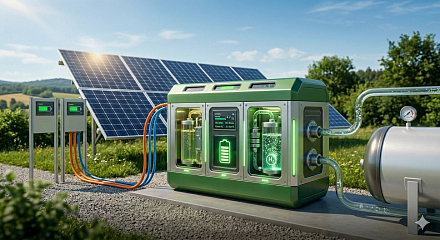
Lithium-ion batteries dominate the market today, but in large-scale energy storage they run into issues of cost, safety and raw-material availability. Scientists from China have now presented an alternative that uses iron and an aqueous electrolyte and, according to tests, can withstand thousands of cycles without noticeable wear.
The new so-called all-iron flow battery could significantly help with storing energy from solar and wind power plants. The researchers claim the system completed more than 6,000 charge and discharge cycles without any measurable loss of capacity, which corresponds to roughly 16 years of daily use.
The development comes from a team at the Chinese Academy of Sciences, which published the results in the scientific journal Advanced Energy Materials. If the technology can be transferred from the laboratory into real-world use, it could become one of the most interesting alternatives to today’s more expensive lithium-based solutions.
Iron is one of the most abundant elements on Earth and, in raw form, is significantly cheaper than lithium. This does not automatically mean that the finished battery will be several times cheaper, because the final cost also includes tanks, membranes, pumps and control electronics. However, the material used in the active part is one of the key cost items.
How it works
Unlike conventional batteries in smartphones, laptops or electric vehicles, it does not store energy in solid cells. A flow battery uses liquid electrolytes stored in external tanks, which are pumped through an electrochemical cell during operation.
The advantage is particularly clear in large-scale projects. If higher capacity is needed, it is often enough to increase the size of the electrolyte tanks. This makes the technology a suitable candidate for wind and solar farms, where compact dimensions are not the decisive factor, but rather cost, lifetime and safety.
However, flow batteries have so far faced several problems. In the case of iron-based systems, these mainly included gradual degradation, weaker reversibility of reactions and the crossover of active substances through the membrane, which reduced performance over time.
A key change in the electrolyte chemistry
The Chinese team focused precisely on the weak point of the technology: the negative electrolyte. The scientists tested 12 organic ligands, created 11 iron complexes and ultimately identified a compound labelled [Fe(HPF)BHS]^4-, which proved to be the most stable.
According to the authors of the research, this structure has several advantages. The bulkier molecular arrangement protects the iron centre, while negatively charged groups help repel hydroxide ions. At the same time, the unwanted transfer of substances through the membrane is reduced.
The result is significantly higher stability during long-term operation. During testing, the battery operated at a current density of 80 mA/cm² for more than 6,000 cycles with an average coulombic efficiency of 99.4%. Under higher load, it reached a peak power density of 392.1 mW/cm² and an energy efficiency of 78.5%.
Safety is a major advantage
One of the biggest benefits of the new solution is the aqueous electrolyte. It does not use the flammable organic solvents typical of lithium-ion batteries, which can cause fires if damaged or overheated.
In large battery storage systems, safety is a critical issue. Incidents in various countries have shown that in megawatt-scale systems, the risk of fire can be a serious problem. An aqueous solution therefore represents a strong argument.
For now, however, it is important to remain realistic. Laboratory success does not automatically mean a commercial product. The researchers have not yet announced a pilot project or a production plan. However, if the same parameters can be confirmed at large scale, iron could become a significant player in energy storage, especially at times when the sun is not shining and the wind is not blowing.
Source: https://fontech.startitup.sk/